--%>

Compute the stoke statistics

Please do the following and submit your results in the table format in a word file on canvas:

a)      Go to Yahoo finance/Investing/Stocks/Research tools/Historical quotes/Historical prices and download adjusted monthly closing prices for the period 1/1/2006 to 31/12/2012 for:

Exxon (XOM)

Walmart (WMT)

S&P 500 (^GSPC)

b)      Sort data from oldest to newest record.

Compute monthly returns for each stock and index:

Return at time t = (Pt-Pt-1)/Pt-1

c)      Compute the following statistics for each stock and the index:

        i.            Average monthly return

        ii.            Geometric monthly return and the corresponding annual return.

        iii.            The monthly standard deviation and corresponding annual standard deviation

        iv.            Use the monthly returns and compute the correlation between each pair (Exxon-Walmart, Exxon-S&P 500, Walmart-S&P 500).

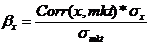
        v.            What is the beta for each stock? The beta for stock x is given by the following formula,
2374_Untitled 12.png

Please present your results in the following format:

Statistic

Exxon

Walmart

S&P 500 Index (mkt)

Average monthly return


Compounded monthly return


Annual return


Monthly standard deviation


Annual standard deviation


Correlation


Exxon-Walmart =


Exxon-S&P 500 =


Walmart-S&P 500 =


Beta


   Related Questions in Basic Statistics

  • Q : Calculate the p- value Medical tests

    Medical tests were conducted to learn about drug-resistant tuberculosis. Of 284 cases tested in New Jersey, 18 were found to be drug- resistant. Of 536 cases tested in Texas, 10 were found to be drugresistant. Do these data indicate that New Jersey has a statisti

  • Q : State the hypotheses At Western

    At Western University the historical mean of scholarship examination score for freshman applications is 900. Population standard deviation is assumed to be known as 180. Each year, the assistant dean uses a sample of applications to determine whether the mean ex

  • Q : Report on Simple Random Sampling with

    One of my friend has a problem on simple random sampling. Can someone provide a complete Report on Simple Random Sampling with or without replacement?

  • Q : Hypothesis homework A sample of 9 days

    A sample of 9 days over the past six months showed that a clinic treated the following numbers of patients: 24, 26, 21, 17, 16, 23, 27, 18, and 25. If the number of patients seen per day is normally distributed, would an analysis of these sample data provide evidence that the variance in the numbe

  • Q : Derived quantities in Queuing system

    Derived quantities in Queuing system: • λ = A / T, Arrival rate • X = C / T, Throughput or completion rate • ρ =U= B / T, Utilization &bu

  • Q : Statics for each of the following

    for each of the following studies a and b decide whether to reject the null hypothesis that groiups come from identical populations. Use the .01 level. (c) Figure the effects size for each study. (d) ADVANCED TOPIC: Carry out an analysis of variance for study (a) using the strucurtal method.

  • Q : MANOVA and Reflection Activity

    Activity 10:   MANOVA and Reflection   4Comparison of Multiple Outcome Variables This activity introduces you to a very common technique - MANOVA. MANOVA is simply an extension of an ANOV

  • Q : Define Service Demand Law

    Service Demand Law:• Dk = SKVK, Average time spent by a typical request obtaining service from resource k• DK = (ρk/X

  • Q : What is Forced Flow Law Forced Flow Law

    Forced Flow Law: • The forced flow law captures the relationship between the various components in the system. It states that the throughputs or flows, in all parts of a system must be proportional t

  • Q : Data Description 1. If the mean number

    1. If the mean number of hours of television watched by teenagers per week is 12 with a standard deviation of 2 hours, what proportion of teenagers watch 16 to 18 hours of TV a week? (Assume a normal distribution.) A. 2.1% B. 4.5% C. 0.3% D. 4.2% 2. The probability of an offender having a s