--%>

Changes in supply and demand curves

This alters in the supply- and demand-curves for textbooks could not have resulted from a change in: (w) taxes. (x) relative prices for text books. (y) expectations about future prices. (z) prices for related goods.
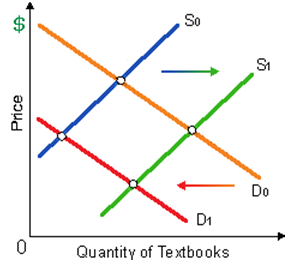
924_demand for textbooks.png

Hello guys I want your advice. Please recommend some views for above economics problems.

   Related Questions in Microeconomics

  • Q : Change in total revenue by market power

    When a monopolist raises price, it: (w) always increases its revenue. (x) always reduces its revenues. (y) doesn't influence its revenue. (z) may increase, decrease, or not change total revenue. I need a good answe

  • Q : On which point demand appears to be

    On this demonstrated figure of demand curve for DVD games, demand appears to be approximately unitarily elastic at: (w) Q = O, P = $50. (x) Q = 10, P = $O. (y) Q = 5, P = $25. (z) No point on the demand curve.

    Q : What is Complements Complements : The

    Complements: The two goods for which a rise in the price of one good leads to a reduction in the demand for other.

  • Q : Graphical explanation of production

    The production possibilities frontier graphically demonstrates the: (i) Production limitations which confront the society. (ii) Benefits inherent in the capitalistic economy. (iii) Social selections available if technology is boundless. (iv) Structura

  • Q : Greater economics loss than fixed costs

    Within the short run, there a monopolistically competitive firm will NOT operate at: (w) an economic loss that is less than fixed costs. (x) an economic loss that is greater than fixed costs. (y) making a normal profit. (z) making economic profits.

  • Q : Problem on price elasticity and total

    A) Use the table below to draw graphs that show the relationship between price elasticity of demand and total revenue. <

  • Q : Purely competitive price takers and

    Different from Firm D, Firms A and B as well as C are all: (w) profitable firms that enjoys significant market power. (x) purely-competitive price-takers and quantity-adjusters. (y) pure monopolies. (z) perfectly inelastic suppliers.

    Q : Explain about term market failure The

    The phrase "market failure" refers to: (w) the failure of market economies to deal with social problems. (x) the Stock Market Crash of 1929. (y) cases where supplies and demands within private markets yield inefficiency, excessive or inequity instabil

  • Q : Bargaining situation of Asymmetric

    Whenever two parties encompass unequal levels of knowledge regarding issues in the bargaining situation: (i) Potential abuses of the asymmetric information exist. (ii) The payoff matrix is invariably asymmetric. (iii) The more knowledgeable negotiator will profit from

  • Q : Shortages and surpluses in the market A

    A shortage as in below graph, during this market for papayas would match up to line: (1) ab. (2) cd. (3) ac. (4) bd. (5) ae. 1802_example</span></p>
                                        </div>
                                        <!-- /comment-box -->
                                    </li>
   
   </td>
	</tr>
</table>


                                </ul>
                                <!-- /user-comments-list -->
                            </div>
                        </div>
                    <div  class=

    Discover Q & A

    Leading Solution Library
    Avail More Than 1421410 Solved problems, classrooms assignments, textbook's solutions, for quick Downloads
    No hassle, Instant Access
    Start Discovering

    18,76,764

    1923222
    Asked

    3,689

    Active Tutors

    1421410

    Questions
    Answered

    Start Excelling in your courses, Ask an Expert and get answers for your homework and assignments!!

    Submit Assignment

    ©TutorsGlobe All rights reserved 2022-2023.