--%>

Break-even on profit-maximizing strategy

Robomatic Corporation would exactly break-even upon its RoboMaids when, instead of exactly identifying its profit-maximizing strategy, this: (i) operated at point i, charging only $10,000 per unit and producing 16,000 robots. (ii) priced each robot at $24,000 but sold only 1,800 robots each month. (iii) charged $16,000 per robot and sold 10,000 robots per month. (iv) produced 6,500 robots per month as well as sold them for $18,000 apiece.
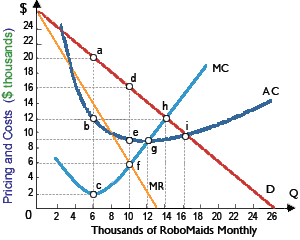
488_Elasticity and profit.png

Hello guys I want your advice. Please recommend some views for above Economics problems.

   Related Questions in Microeconomics

  • Q : Market structure of oligopoly firm

    Assume that a firm is conscious which rival firms will adjust to counter any changes in the firm’s policies and accordingly, the firm behaves strategically while this sets prices, terms to customers or output levels. That a firm is operating in a market

  • Q : Inter-temporal Costs and Benefits

    Harvey is currently a Junior Analyst at a financial firm.  His annual salary is $30,000, and past experience leads him to believe that the real (inflation adjusted) value of his salary will remain at that level in the future.  (Assume he is paid at the end o

  • Q : Changes in price influencing supply

    Describe how changes in the prices of other products influence the supply of a specific product.

  • Q : Income effect of a small change in wage

    The income effect of a small change within wage rate is approximately identical to the substitution consequence for Glynn at: (i) point a. (ii) point b. (ii) point c. (iv) point d. (v) point e.

    Q : Define Inferior good Inferior good : It

    Inferior good: It is a good for which, other things equivalent, a rise in income leads to a reduction in demand.

  • Q : Short-run equilibrium of

    A purely-competitive, short-run equilibrium does NOT need which each firm: (w) produces where MC = MR = P > min(AVC). (x) experiences no excess demand or excess supply. (y) earns only zero economic profit. (z) adjust output hence m

  • Q : Needs by marginal revenue equals to

    A monopolist produces where marginal revenue [MR] equals marginal costs [MC] when it needs to maximize: (i) total revenue. (ii) consumer surplus. (iii) profits. (iv) total revenue, producer surplus and profits. (v) job security.

  • Q : Difference among change in

    The difference between change in supply and change in quantity supplied is as follows: (1) The change in quantity supplied is caused just by the change in the price of good, whereas a change in supply takes place whenever the ceteris paribus suppositi

  • Q : Price increment in elasticity A price

    A price hike $4 to $5 per slice of pizza because of total revenue to: (w) fall. (x) remain constant. (y) rise. (z) this is not possible to tell from such data.

    Q : Persistent range of output by economies

    When economies of scale are persistent across the range of output which people might feasibly purchase, in that case: (w) pure competition is the most efficient market structure. (x) competition will prevent monopolization of the industry. (y) competi